
The production of too many useful things results in too many useless people!
Karl Marx
If we do not realize that the dysfunctionality of individuals is the major problem of our civilization, whatever the idea we generate is futile.
Tinaz Titiz, Letter to Friends, 2019-07
The Political Equality principle delegates the authority of sovereignty to the public opinion, emerges from a mass, constituting high ignorance about governance and vulnerability for manipulations. Because of this, Democracy becomes a platform for caprice of ignorance and even its tyranny.
Ahmet Arslan, Introduction to Philosophy, pr.26, pg.195
There are two kinds of Democracy, hard and easy. The Hard-Democracy is the one trying to solve the education problem of the public who demands justice based judiciary system. The Easy-Democracy, on the other hand, is in the control of demagogues manipulating the opinion of the ignorant citizens.
I. H. Tonguc, Deputy Minister of Education in Turkey, 1950’s
Ancient Greeks are the father of the name ‘poli-tika’ meaning ‘affairs of the city[1]. They are also the founder of todays’ modern management mechanism ‘Democracy’. Some adjustments had been implemented by modern time philosophers: John Locke – Liberal Democracy, J. J. Rousseau – Absolute Democracy and Karl Marx – Communist Democracy. But the foundational idea is still belongs to our ancient ancestors.
Greeks invented and used this system in order to integrate votes/thoughts/decisions of each citizens in an optimum way. Ancient theaters were not build only for fun but also for this attempt of information integration. But the number of citizens has to be at a manageable level for such kind of a physical integration try-out.
It is estimated that from the beginning of modern human existence to the Agricultural Revolution, the human population increased to approximately 10 million in 200.000 years. After the invention of agriculture, the increasing trend of human population became exponential and the population of our species reached 250 million in only 12.000 years, till the birth of Christ. But this was just the tip of the iceberg (Figure-1). With the help of the usage of steam engines and electricity (mass production) and following industrial revolutions (digital and cyber) our density on earth made an enormous jump from 1 billion (in 1800s) to 7.7 billion in 2019 in only 2 centuries [2].
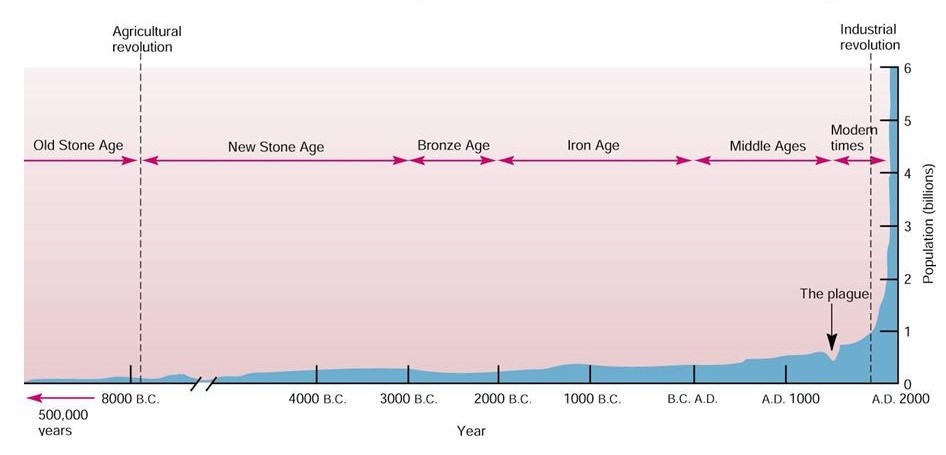
Settlements spread over larger areas on the earth and digital but non-interactive data transmission mechanisms/technologies (telegraph, telephone, radio and television) were not capable of helping us to perform a near real-time, inclusive, pluralistic information sharing platform and so to say a ‘Direct-Democracy’. Building hierarchical and intermediate layers between citizens and decision/executions was much more easy and obviously was the only choice for the sake of society, till the last decade of 19’th century, when ‘World-Wide-Web’ came to life.
Having a kind of central authority, such as theocracy, tyranny/monarchy, oligarchy/aristocracy and ochlocracy/democracy [2], was a necessity for managing increasing population on the Earth. Maybe that was the best option for creating a decision-pipeline between citizens and executions in those times. The information process mechanisms were not sophisticated as they are today.
Representative Democracy is the modern choice of our generation to establish a central authority and its inheritance originated from the era of the classical Roman civilization [4], Roman Republic (509-27 BC), before the establishment of Roman Empire. This indirect mechanism of democracy toke the lead of power by crowding out the Roman Assemblies where ordinary citizens, not only the elected representatives, were balloting in the legislative institutions of ancient Rome.
This new mechanism was ‘representative’ because citizens delegate their authority of sovereignty to the elected ones and generally wait for years to make new judgements/evaluations unless a significant political, economical or military crisis/discontent occur.
Main problems of this system are asymmetry, latency and forgery of the information being shared between decision takers and citizens.
- Asymmetry, due to the unwillingness/afraid of sharing power
- Latency, due to the complex hierarchy between parties
- Forgery, due to the conscious or unconscious manipulation of truth
Let’s call all of them in one terminology, ‘Disparity‘. This ‘disparity of information’ between the two sides in any political system has the potential of causing catastrophic events like:
- social rebellions against unfairness and inequality,
- economical crises due to populist decisions,
- military defeats or coups due to managerial conflicts,
- brain migration because of the oppressive atmosphere,
- surveillance of manipulators on ignorant millions (ochlocracy) and
- negative feedback loops of all of these.
Our ancestors tried to overcome this inefficiency and vulnerability problem of Democracy by proposing alternative (quick-path) mechanisms like Monarchy and Aristocracy, which offer lower participation/integration but hasty actions. Especially, after the great defeat of Greeks by Persians (Second Persian Invasion of Greece), philosophers changed their mind in the direction of “one-hand ruler” type systems. Socrates and his student Plato were the famous defender of a monarchic system where a nation get the chance of a quick cooperated response to the enemies, even there exist lots of distributed cities/states in the country/empire.
We saw such kind of managing attempts right after the Roman Republic, in the Roman Empire, such as dominant rulers (dictators) like Alexander the Great (336-324 BC) or Gaius Julius Caesar (59-44 BC). Particularly the military expeditions of Greeks to the Eastern world had also catalyzed the penetration of the despotism into the Western civilization.
On the other hand, a monarchic system has its own disadvantages. Its success is totally depend on the wisdom of the ruler and naturally this dependency causes volatility on the trend of the prosperity of the nation. If the selection mechanism of the monarch does not include any merit but only proximity of blood, the volatility of prosperity becomes eventually severe. Our history is filled with such kind of examples (Mongol Empire, Ottoman Empire, Persia, etc.) suffered from inconsistent policies which did not have social responses and mutuality. Think of, one ruler changes the all policies that former one established, and the successor one again bring them all back, reversed the all. But nothing was related to the actual necessities of the citizens!
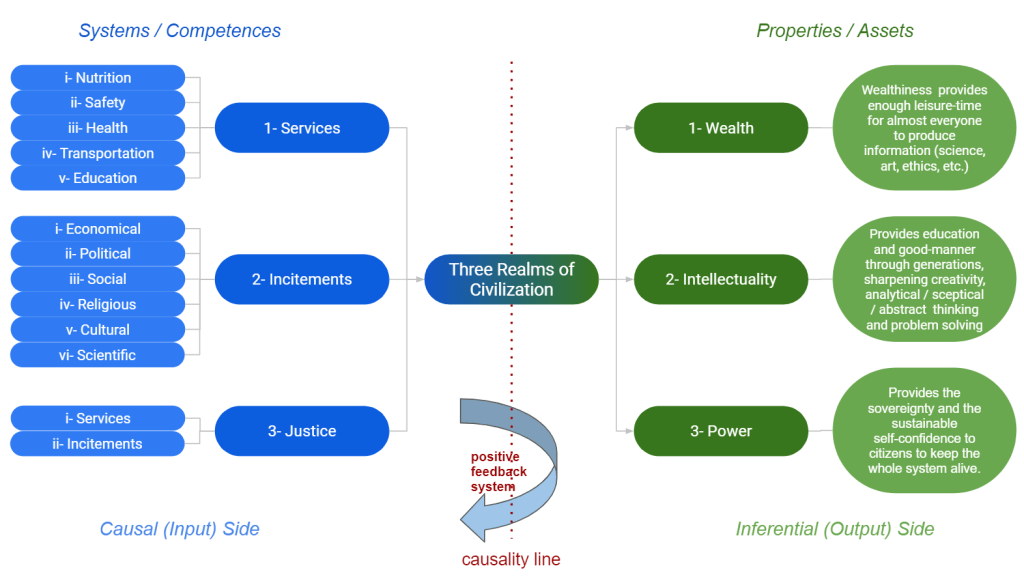
A postmodern society deserves better! We have build our civilization with thousands of year of efforts and sacrifices. Its current structure is deliberately and inexorably complicated but a shortcut schema (Figure-2) is given below as a diagram, hoping to help readers to create a concrete imagination about mechanisms in a society, and easily realize the necessities and possible promises (healing points) of the new system being proposed. This figure illustrates ‘Three Realms of Civilization’ with 2D perspective: “Causal/Systems/Competences” and “Inferential/Properties/Assets”.
Strong societies suddenly emerges from a spark of a kind of wealth (natural sources like petroleum) or power (military or religion based dictatorships) [5]. They needs sustainability of that spark to gain the chance of becoming a civilization, a complex type of society. History amplifies the importance of this by writing collapses of many victorious emperors/shahs/monarchs.
However, passing to the sustainable stage of civilization needs different type of systems/competences like: 1- Broad Services, 2- Inclusive Incitements and 3- Fair Judicial System. In brief, civilization needs running-systems rather than intrepid-Caesars. The scope of the first competence (Services) can be understood clearly by just looking the details in ‘Figure-2’. The elements under the title of Services evoke the first 3 stages of the ‘Maslow’s Hierarchy of Needs’ pyramid. The content of the second one (Incitements) demands more precise definitions. Incitements/Incentives for:
- Economical aspects means encouraging citizens with monetary subventions, mentory incubation centers and entre/solo-preneurship guidance.
- Political aspects means encouraging freedom of speech, open, distributed and trustworthy participation platforms for citizens to govern.
- Social aspects means encouraging charitable activities, non-governmental organizations who are supporting free governmental services.
- Religious aspects means encouraging freedom of belief by providing peaceful environment for citizens to live in the way of their believes.
- Cultural aspects means supporting artistic, sportive, aesthetic, historical and intellectual activities catalyzing the social development.
- Scientific aspects means supporting systematic, objective, technological and positive problem finding and solving activities of our species in the sake of humanity, nature and universe.
And finally, the third competence ‘Justice‘ means as simple as it can be that justice in the distribution of Services and Incitements. It should be perennial and perpetual!
With the help of these established infrastructure, a young, oil-rich society under the sovereignty of a dictator will capture the chance of having longer, stable and peaceful future including the properties like: 1- Broad Wealth, 2- Inclusive Intellectuality and 3- Fair Power which eventually come together and give rise to the Prosperity: happy, healthy and wealthy nations!
In summary, having a system including ‘Three Pillars’ of the causal-side of the civilization cycle will cover the first three stages (physical, safety, belongingness) of the ‘Maslow’s Hierarchy of Needs’ pyramid and make us ready to jump the right side of the ‘Figure-2’, inferential-side, which is covering the last two stages of the pyramid, Self-Esteem and Self-Actualization.
Monetary wealthiness of a society will most probably provide a qualitative Services (nutrition, safety, health, etc.) infrastructure. But this monetary (materialist) look detain us to realize the much wider and latent potential of wealthiness, Leisure-time, which has a direct and strong relationship with Self-Esteem and Self- Actualization!
A Development Systematic can be easily designed, thanks to money-time relationship. In a well-organized (where rule of law and human rights are respected) Capitalist systems money tends to concentrate on: 1- well educated, 2- productive and 3- wide worldview individuals. Those people, gaining more money and hence more Leisure-time, will spend more time on 1- intellectual/artistic works, 2- scientific investigations, 3- experimental initiates and 4- revolutionary ideas with the help of the guidance of their education and good-manner, hence their conscience. They get used to find and perform structural-hobbies related to those activities, easily and more frequently. Aspects, distinguishing a developed society from others and bringing prosperity to it, are hidden in the aforementioned mechanism.
One can see that this mechanism works exactly in the same way when looks at the history of Science. 1- establishment of Accounting and Geometry by Egyptian priests, 2- discovery of water’s buoyancy power and shape of the Earth by ancient Greek philosophers/aristocrats and 3- development of Astronomy and Cosmology disciplines by Christians priest were not a coincidence. All those personalities[6] had been living in such kind of a prosperity providing free time to invent on.
On the other hand, there are types of Capitalism and today most broad one is the Crony one where proximity based relationships between entities and individuals dominates merit and competences. And in this kind of system, money tends to concentrate on: 1- ignorant/uneducated, 2- lack of good-manner and 3- no structured hobby/interest individuals having no idea of spending their time more efficiently and beneficially. Unfortunately, these people mostly listen their greedy feelings (savage instincts) to take pleasures of life, they prefer to live as consumers rather than being a producer and do not respect to nature. Therefore those countries being populated by that kind of sluggish, braggart and uncouth citizens will fall in the ‘Middle Income Trap‘. And once has been fallen, it will be though to rescue itself from that negative feedback loop! Almost impossible in Capitalist order.
According to the Materialist look of the history, the economical order that a society adopted, will fatefully determines the all other inner-mechanisms it has, like law, politics, science, etc. Capitalism, dominating-order of our civilization, has been doing the same thing to our world, shaping the Judiciary system allowing platforms to facilitate its business, the Politics catalyzing working flow and further engagements with it, the Science concluding and directing society to what Capitalism wants/needs to see.
What we arrive today is the environmental, economical and humanitarian catastrophes, negatively being fed by Inequality in any aspects but especially in the income perspective according to Materialist view. Leaving a man in the maelstrom of misery to fight his rivals having superior capitalist equipment (advanced information technologies) is like watching a game with pleasure, which you know will most probably result in disaster. We need a supportive, catalyzer and fair Incitement system for them who need positive discrimination in order to take a safe and dignified role in the stage of society.
An urgent and may be the only solution for this calamity is empowering the system being proposed or any other with similar intentions and sensitivities. Please do not fall in a mistake that this system is a member of the impractical and clumsy family of Communist manifesto! Because they usually and foolishly concentrate only on the Equality fact without taking any other reality of life like justice, merit and spirituality into account and hence are treating individuals as a machine. Achieving to defeat a half millennium victorious system (Capitalism) needs much more intelligence and wisdom than a pure and dogmatic communist approach has.
We need to build, strengthen and sustain a intelligent, open and transparent political system, which will help us to use technology in the way of integrating citizens to executions, people to actions, individuals to decisions and provide opportunities that each individual can easily find a place to serve society, get the feeling of usefulness, the dignity! Then we may get the chance of diminishing the redundancy effect of technology on humans’ life, like Karl Marx postulated as ‘uselessness’.
To create a more peaceful society having less interior-conflicts between socioeconomic classes, maybe it would be better to listen Aristotle’s warning on Democracy: “It cannot be performed in a society where both high and low classes sharing the power. Because, both are big and small thieves, respectively. Democracy needs middle class on charge!“.
A middle-class, having enough:
- intellectuality to initiate and support realistic and reasonable politics,
- merit to design solutions for problems caused by homo sapience or nature,
- earning and hence leisure-time to gather cross-disciplinary hobbies (R&D),
- ethics and hence conscience to respect to and collaborate with others and
- self-awareness and self-actualization bringing conscious of duty and hence fullfillment of life, i.e. happiness.
This is not an aggrandizement of middle-class but rewarding and protecting its members who are eligible and capable of protecting prosperity oriented systems like being proposed here. Fortifying this class also eventually destroy the savage conditions and results of Inequality problem of modern capitalist world that we already converged.
Below a list of 5 main perspectives are given as a taxonomy for clustering the highly possible problems expecting our species and the corresponding treatments being promised by the new system. In other words, reasons for why we need to shift our current political system to the newly proposed one are listed below as headlines comprising the details in it.
- Economical Perspective
- Political Perspective
- Ecological Perspective
- Scientific Perspective
- Humanitarian Perspective
References:
[1] A city-state is an independent sovereign city which serves as the center of political, economic, and cultural life over its contiguous territory. They have existed in many parts of the world since the dawn of history, including cities such as Rome, Athens, Sparta, Carthage, and the Italian city-states during the Middle Ages and Renaissance, such as Florence, Venice, Genoa and Milan. With the rise of nation states worldwide, only a few modern sovereign city-states exist, with some disagreement as to which qualify; Monaco, Singapore, and Vatican City are most commonly accepted as such. (wikipedia)
[2] https://www.scielo.br/scielo.php?pid=S2197-00252013000300001&script=sci_arttext
[3] Management types are given in an ascending order wrt their propagation degree of sovereignty. And the slash makes the Greek separation of bad/good versions of them.
[4] Over the times, while there were popular elections in each year, the democracy in the Republic turned to be an oligarchy, as a small number of powerful families (called gentes) monopolised the main magistracies.
[5] According to the writings of Giambattista Vico, western founder of history of philosophy, societies can be build only with power and violence. And the most helpful things for the founders are religion and its rituals.
[6] (Nicolaus Copernicus – priest – Astronomy), (Gregor Mendel – priest – in Genetic), (Thomas Bayes – priest – in Statistics), (Roger Bacon – priest – in Empiricism), (F. Maria Grimaldi – priest – Physics), (Georges Lemaitre – priest – in Physics)
 IntelligentDemocracyProject